The Platform
One platform. Built to adapt.
Most heavy-lift aircraft do one job well. TITAN changes job in minutes — the payload changes, nothing else does.
Mission ready
Out of the vehicle and standing by in under two minutes. Designed for rapid deployment wherever the mission starts.
Payload agnostic
Cargo. Sprayer. Winch. Medical. Sensors. Changing role takes a payload, not a purchase order.
Built for harsh environments
20,000 feet. Dust, heat and cold. The conditions that ground other aircraft are the ones it was rated in.
Autonomous operations
Waypoint missions, terrain-referenced flight and layered failsafes. Operators supervise the mission rather than fly the aircraft.
Low operating cost
Battery powered. Minimal ground crew. Rapid turnaround between sorties. More time moving payloads, less time servicing equipment.
Heavy lift, honestly rated
Designed to carry meaningful payloads without requiring a different aircraft.
Configure
Your mission changes. The aircraft doesn't.
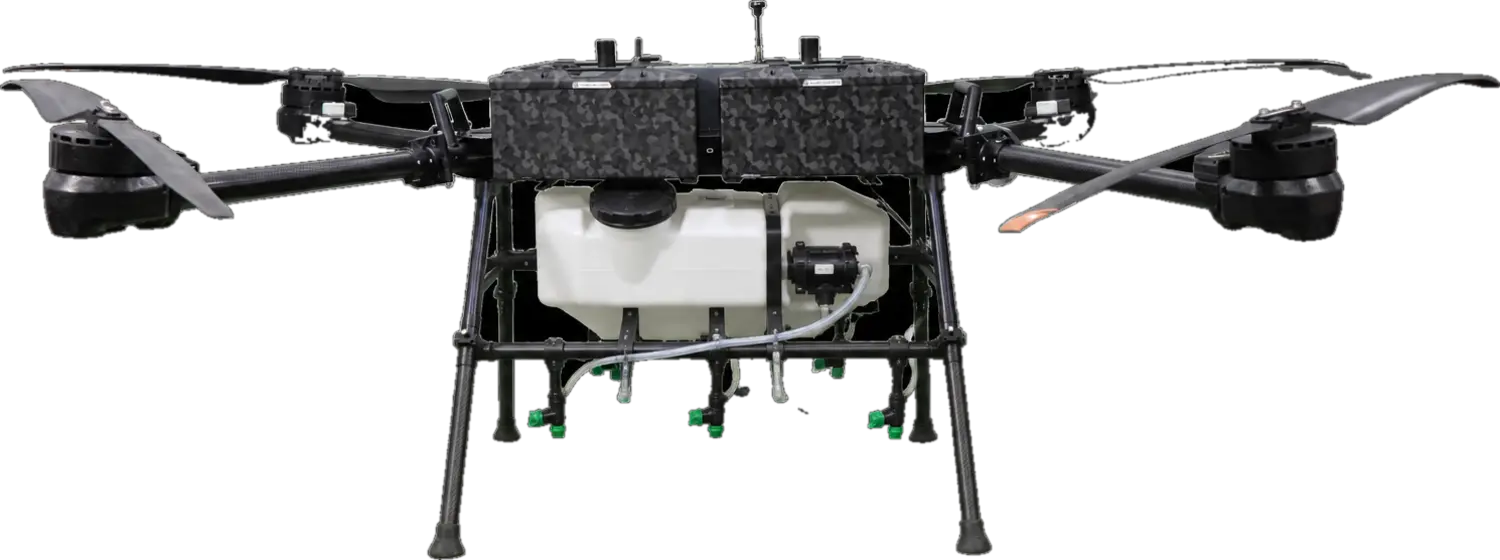
Only what hangs underneath changes. Train an operator once and they can fly every configuration.
Agriculture
Specifications
Every claim above, in numbers.
One architecture, two sizes. The only question is how much you need to move.
| Parameter | TITAN 30 | TITAN 60 |
|---|---|---|
| Performance | ||
| Max payload | 66 lb (30 kg) | 132 lb (60 kg) |
| Max take-off weight | 198 lb (90 kg) | 331 lb (150 kg) |
| Cruise speed | 40 mph (64 km/h) | |
| Operational ceiling | 20,000 ft | |
| Range | 19 mi (30 km) | |
| Cargo volume | 7 ft³ (200 L) | |
| Deployment | ||
| Unfolded dimensions | 7 × 3 × 7 ft (2.1 × 0.9 × 2.1 m) | 8 × 3 × 8 ft (2.5 × 0.9 × 2.5 m) |
| Folded dimensions | 2.3 × 2.3 × 3.9 ft (0.7 × 0.7 × 1.2 m) | 4.4 × 2.5 × 4.4 ft (1.35 × 0.75 × 1.35 m) |
| Folded volume | 21 ft³ (0.6 m³) | 48 ft³ (1.37 m³) |
| Unload to standby | Under 2 minutes | |
| Environment | ||
| Operating temperature | −4 to 113 °F (−20 to 45 °C) | |
| Systems | ||
| Flight modes | Autonomous & manual | |
| Inertial | Triple-redundant IMU | |
| Navigation | Dual RTK GPS | |
| Heading | Mag-field-independent estimation | |
| Altimetry | LiDAR altimeter | |
| Power | Four independent batteries | |
| Airframe | Aluminium frame · carbon arms & booms | |
Rows marked common are identical across both aircraft · Range varies with payload, altitude and weather
Engineering
Built to keep flying when something doesn't.
At altitude with a load on, there is no margin for a single point of failure. Everything that could strand the aircraft has a second path.
Triple-redundant IMU
Three independent inertial units voting on attitude. A drifting sensor is outvoted, not followed.
Dual RTK GPS
Centimetre-class positioning, with a second receiver carrying the mission if the first degrades.
Mag-independent heading
Heading estimation that does not rely on the magnetic field — the failure mode that ends most heavy-lift flights near steel and high current.
Four independent batteries
Separate packs on separate paths. Losing one is a degraded sortie, not a falling aircraft.
LiDAR altimetry
True height above ground for terrain-referenced flight, low-level work and precise set-down on unprepared surfaces.
Hybrid airframe construction
Aluminium structural frame, carbon-fibre arms and carbon boom tubes — stiffness where the loads are, light weight where they are not.
Protected avionics enclosure
Rated −20 °C to 45 °C. Dust, damp and thin cold air are operating conditions, not exceptions.
Rapid payload integration
A common mechanical, power and data interface, so a new payload becomes a supported configuration rather than an engineering project.
Get in touch
Tell us the mission. We'll configure the platform.
Send us the load, the distance and the terrain. We'll come back with a configuration and the numbers behind it.